Every time a new agent framework drops, the first question I get is "what does the API look like?" and it is almost always the wrong question. I have watched GCP teams adopt Google's Agent Development Kit for the wrong reason (it has a nice decorator for tools) and skip the actual reason it earns its place in a regulated shop. The decorator is fine. So is the one in LangGraph and the one in CrewAI. That is not where the money is. The ADK enterprise story is an eval gate you cannot route around and a policy layer that sits at the runner, and both of those are boring in exactly the way production likes.
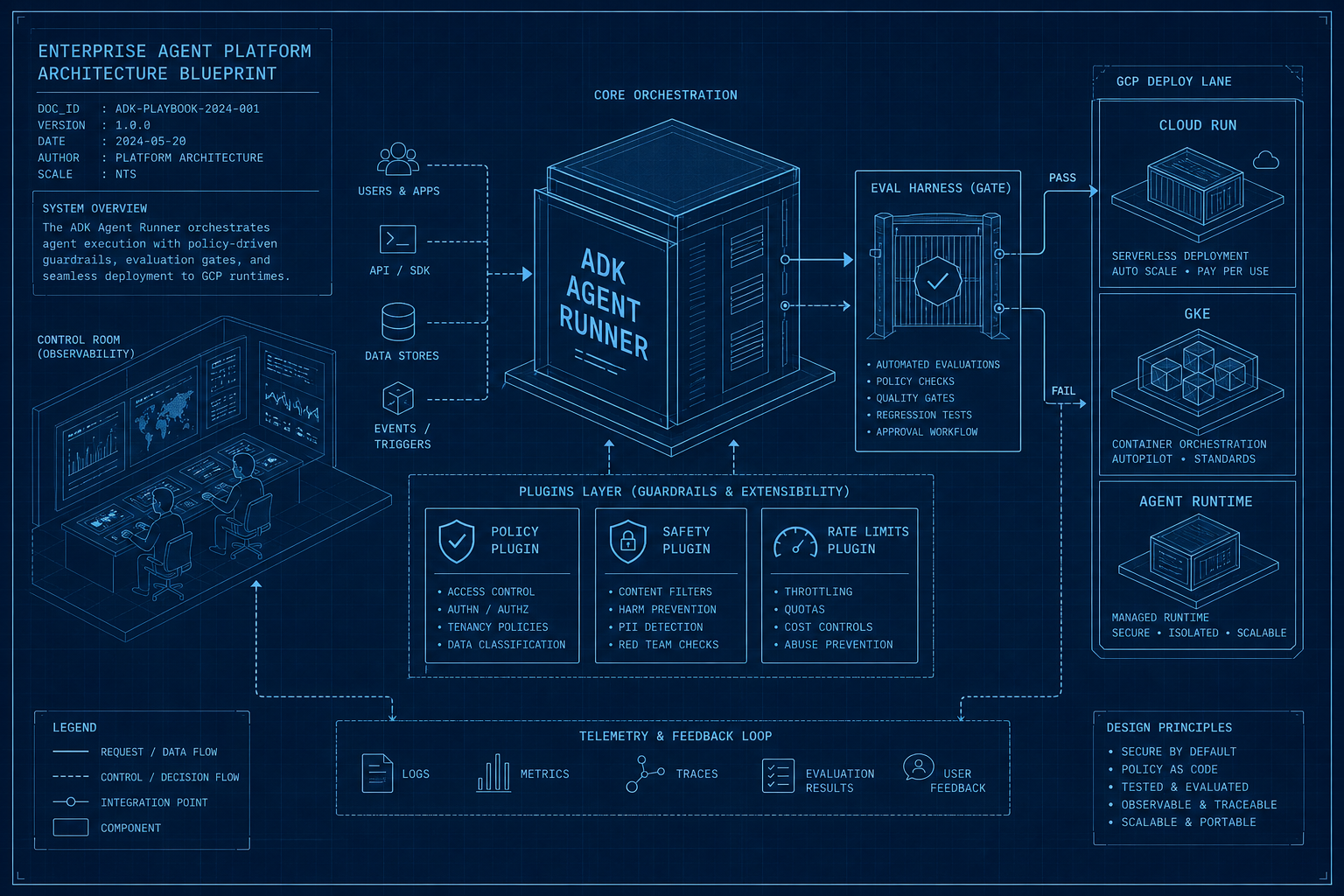
So before we touch syntax, the thesis, stated plainly so you can disagree with it: ADK is worth adopting when you already live in Google Cloud, and the value is governance plus eval, not API surface. If you are multi-cloud and portability is your top constraint, this is not your framework, and I will say so again near the end. Let me walk the stack the way I would in a design review.
The shapeCode-first, model-agnostic, GCP-deepest
Start with what ADK actually is, because the marketing and the reality differ in a useful way. Per the Google Cloud docs, you define agents, tools, and orchestration in code, which means they are versioned, diffable, and testable like any other software. The kit ships in Python, TypeScript, Go, and Java (with Kotlin called out on adk.dev), so it is not a Python-only toy.
And here is the honest nuance the homepage gets right: ADK is described as model-agnostic and deployment-agnostic, optimized for Gemini and Google Cloud but not locked to them. Both halves of that sentence are true and both matter. You can point it at another model. You will just feel the gravity well of Gemini and GCP the moment you want the parts that make this worth it. As the docs put it, you "start with agents and tools and grow into sophisticated multi-agent systems." Fine. The growth is the easy direction. The governance is the hard one, and that is where ADK pulls ahead of a bare LangGraph build.
Figure 1 · The build lane
Code-first to eval gate to GCP deploy, in one pass
Why the eval gate is the headline, not a footnote
If you have read my other notes you know I will not shut up about golden traces, so this is the part of ADK I am genuinely happy about. Evaluation is built in, and it runs against execution trajectories and test cases, not just final-answer string matching. That distinction is the whole game. A trajectory eval asks "did the agent take the right steps in the right order," which is the failure mode that bites you in week two when the answer looks right and the path that produced it was nonsense.
Wiring this as a gate, eval before deploy, is what converts a nice feature into a control. The team I trust most on this treats a trajectory regression exactly like a failing unit test: it blocks the pipeline. If your golden-trace mindset is still forming, an interesting read for that is the agent eval harness blueprint, which lines up almost one to one with how ADK wants you to score runs. The kit gives you the runner; the harness mindset gives you the discipline to not route around it on a Friday.
Governance
Plugins at the runner beat callbacks per agent
Here is the design decision that separates a hobby project from a fleet you can defend in a security review. ADK lets you enforce policy two ways: a before_tool_callback bolted onto an individual agent, or a plugin registered at the runner that sees every agent. They look similar in a tutorial. They are not the same thing in production.
"Plugins are the recommended approach for implementing policies that are not specific to a single agent." (Google ADK safety docs)
Read that as the load-bearing sentence it is. A per-agent callback is a policy that one author remembered to add to one agent. A runner-level plugin is a policy your platform team applies once and every current and future agent inherits it. In a multi-tenant shop the second one is the only one that survives an audit, because "we hoped each team added the guardrail" is not a control, it is a wish.
Figure 2 · The governance ring
One runner plugin, every agent governed
Who signs off before production?
That question is the one your risk team will actually ask, and ADK plugins give you a place to answer it in code. This is where the community toolkit gets fun. adk-agentmesh describes itself as "policy enforcement, trust verification, and audit trails for Google ADK agents," and it maps a before_tool_callback onto exactly the controls you want at the runner: policy eval, rate limits, and delegation scope. The config sketch is refreshingly readable.
Figure 3 · Policy as config
An adk-agentmesh policy sketch
# adk-agentmesh policy sketch (from examples)
rules:
  - tool: deploy_production
    action: require_approval
  - tool: "*"
rate_limit: 50 per sessionRead those two rules as a starter governance posture. require_approval on deploy_production is your approval gate: the agent can propose the deploy, a human signs it. The wildcard rate_limit is your blast radius cap. Neither is exotic, and that is the point. Good governance is mostly unglamorous defaults applied consistently, which is precisely what a runner-level plugin is for. One honesty flag I owe you: adk-agentmesh is an early public-preview project, so treat it as a sharp pattern to copy rather than a dependency to bet the quarter on.
Deploy lane
Three targets, one inherited control plane
This is the part where being GCP-native stops being a constraint and starts being the reason you chose ADK. The same agent deploys to Agent Runtime, Cloud Run, or GKE, and in every case it inherits the platform's auth, Cloud Trace spans, and VPC controls without code changes. Let me be clear about why that matters: the observability and IAM story you would have to assemble by hand on a portable stack is just there. That is real, and it is the honest upside of committing to the well-lit GCP path.
The flip side, said with the same honesty: "deploy anywhere" still means you own container operations. Cloud Run and GKE are managed, but they are not zero-ops, and a non-GCP team does not get this inheritance for free. If your tools are themselves a fleet of services, the MCP servers production guide is worth a look before you wire them in, because the deploy lane is only as governable as the tool endpoints behind it.
Figure 4 · Before you ship
The four-line ADK enterprise checklist
The counterpoint I owe you
I promised GCP-native honesty, so here it is without the pom-poms. ADK's deepest integration is Gemini and Google Cloud. If your top constraint is multi-cloud portability, a stack of LangGraph plus LiteLLM for model routing will give you more freedom to move between providers, and you should genuinely weigh that against everything I just praised. The governance ergonomics will cost you more hand-assembly on that path, but freedom usually does.
Two more caveats. The community governance ecosystem around ADK, adk-agentmesh included, is still maturing, so plan to read the source and pin versions rather than assume stability. And the "deploy anywhere" line is real only if you already do container ops well; it is not a zero-ops promise for a team that lives outside GCP. None of this sinks the thesis. It scopes it: ADK is a strong yes for a GCP-committed team that values eval and governance, and a "look harder at alternatives" for a portability-first one.
Wrap-upAdopt the gate and the ring, not the syntax
If you take one thing from this, let it be the reframing: do not evaluate ADK on how its tool decorator feels. Evaluate it on whether the eval gate and the runner-level policy plugin match the controls your organization actually needs. That is where it beats a bare framework build, and that is the part the quickstart will not sell you because it is unglamorous.
Do this this week
Take one existing agent, write four trajectory test cases for its happy path and three failure paths, and wire them as a gate so a regression blocks deploy. Then move your scariest tool guard from a per-agent callback to a runner plugin. You will have converted two wishes into two controls, which is the entire ADK enterprise playbook in miniature.
The broader platform story is moving fast too, and a lot of this governance posture is becoming first-class in Google's managed offerings. For where that is heading, it's worth taking a look at the Cloud Next 2026 Agentspace recap, which reads like the managed version of the checklist above.
ADK wins when you already live in Google Cloud. The playbook is governance plus eval, not API surface.
Pick the framework for the constraint you actually have. If that constraint is "ship governed agents on GCP and prove it to an auditor," ADK is a strong, honest yes. Write the eval gate first, register the policy plugin second, and let the decorators be the boring, pleasant detail they were always meant to be.
Comments (4)
Join the discussion
Sign in to comment, bookmark threads, and continue lessons across sessions.