I came to Google Cloud Next 2026 expecting a model fight and left with a platform map. Walking the expo hall in Las Vegas this April, the demos that drew the longest lines were not about a bigger context window or a faster decoder. They were about the boring, expensive part: who an agent is, what it is allowed to touch, where its actions get logged, and how a Fortune 500 ships a thousand of them without losing track of any single one. As a framework person I went looking for the SDK news. What I found was a governance and distribution play wearing an SDK as its front bumper.
If you only read the press release you would think the news was a rename. It is more than that, and it is also less exciting than a rename makes it sound, which is exactly why enterprise buyers should pay attention. Let me lay out what actually shipped, what is genuinely production-ready, and what is still a demo wearing a launch banner.
Cloud Next 2026 · Las Vegas keynote hall
The pilot era is the thing they declared over
The framing came straight from the main stage. Forrester's recap caught the line I keep repeating to my own team: Sundar Pichai contrasted last year's refrain, "Can we build an agent?", with this year's, "How do we manage thousands of them?" That sentence is the whole conference compressed. The implied customer is not a developer trying to get a single agent working. It is a platform owner staring at a sprawl of agents built by twelve teams, each with its own credentials, its own logging, and its own idea of what "done" means.
Once you accept that framing, every announcement falls into place. The model is assumed. The hard problem is the operating system around the model: identity, policy, observability, a place to register what exists, and a runtime that does not require each team to reinvent hosting. That is the gap Google spent the keynote claiming to close.
Figure 1 · The consolidation
Four separate products collapse into one governed surface
So what actually got consolidated?
The clearest summary I read on the floor came from outside Google. UI Bakery's 2026 guide to Vertex AI Agent Builder describes the move bluntly: Vertex AI has been rebranded as the Gemini Enterprise Agent Platform, and Agentspace has been absorbed into the unified product rather than sold as a separate thing. The four-part shape is build, scale, govern, and optimize. That is not marketing decoration. It is the actual product taxonomy, and it maps onto the four problems a platform team has to solve before agents leave the lab.
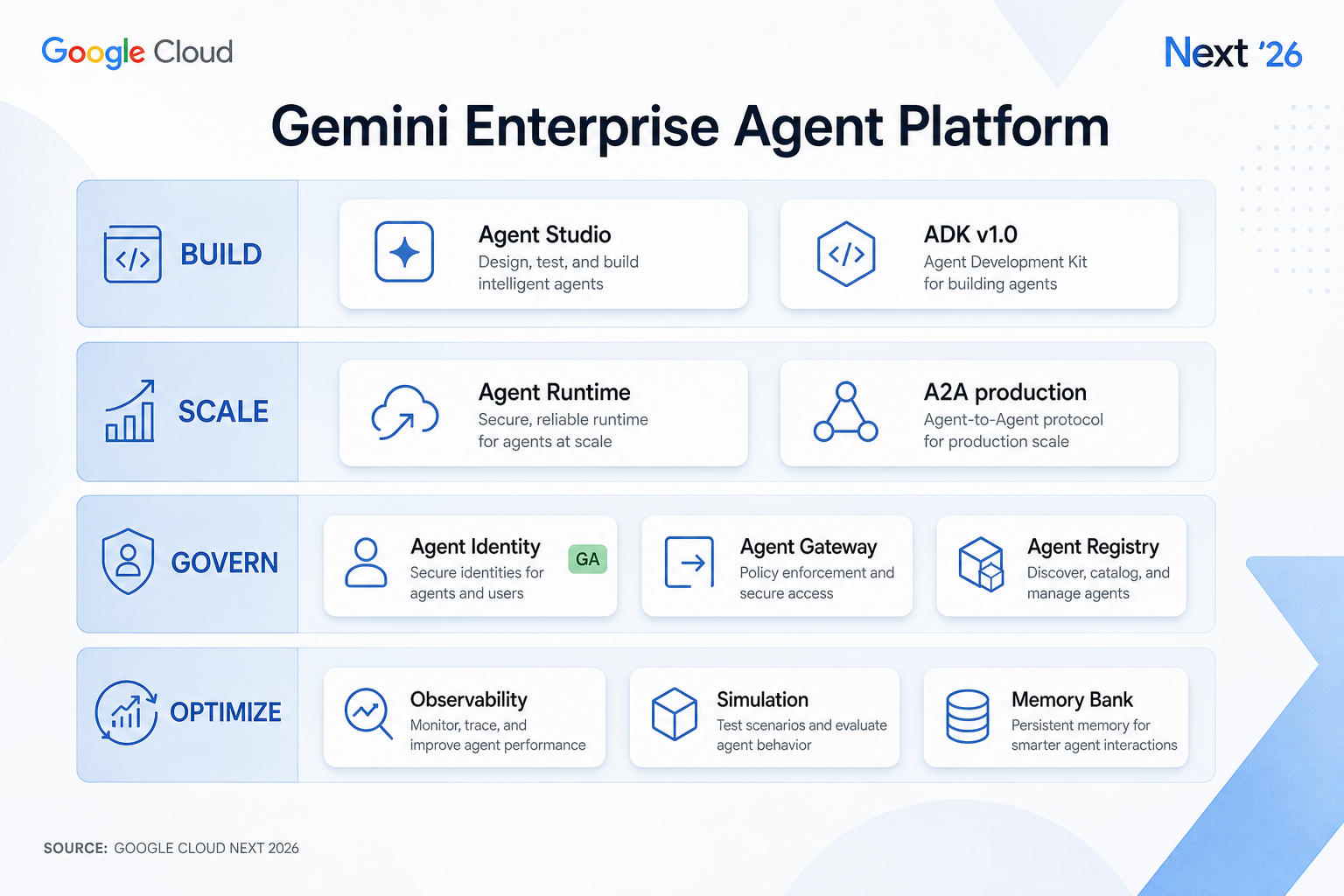
Reading that grid as an engineer, the thing I appreciate is that it admits the lifecycle is more than building. Most agent frameworks I have used are great at the first column and silent on the other three. A platform that names govern and optimize as first-class columns is at least asking the right questions, even where the answers are not finished. If you are weighing the developer-facing side of this stack in more depth, the ADK enterprise playbook goes deeper on the build column than I can here.
The build surface
Two front doors for builders, one runtime underneath
Build splits cleanly into two surfaces aimed at two audiences. Agent Studio is the low-code, natural-language path: describe the agent, wire tools through a UI, ship without writing orchestration code. Then there is the part I actually care about, the Agent Development Kit reaching a stable v1.0. BigGo's launch coverage pins down the details that matter to a framework team: ADK v1.0 is a graph-based multi-agent framework with first-class support across Python, Go, Java, and TypeScript.
The graph orchestration model is the part I am most willing to bet on. A stable, versioned, multi-language SDK with explicit graph semantics is a real foundation, not a wrapper around a chat loop. The four-language commitment also signals they expect this to live inside existing enterprise codebases, not just Python notebooks. That is the bet in the title: ADK v1.0 is the piece most likely to outlast the branding around it, because a graph framework with a 1.0 contract is something you can build against without flinching every quarter.
Where the GA line actually sits
Here is the slide that did not make the highlight reel, and the one every buyer should photograph. Forrester put the caveat in writing: Agent Identity is generally available, and most of the other components are still in preview. That single fact reorganizes how you should read the entire keynote. The platform is announced. The platform is not, today, fully shippable in the way the demo implied.
Figure 2 · Ship tiers
What you can actually deploy versus what you can only pilot
I am not saying preview is worthless. Preview is where you pilot, and Google clearly wants you piloting now. I am saying the gap between "announced" and "deployable" is the single most important number on the slide, and it is the number a vendor keynote is structurally built to blur. Read the tier, not the applause.
The piece that surprised me most was on the wire between agents. Agent2Agent, the A2A protocol, moved to production for cross-platform agent communication, per UI Bakery's writeup. Pair that with the Agent Registry and the Agent Gateway and you can see the shape of a control plane: a registry to know what agents exist, a gateway to enforce policy and catch injection or data leaks at the boundary, and a protocol so agents from different platforms can actually talk.
The registry and the gateway are the real control plane
This is the part that rhymes with a debate already running in the tooling world. Registries and gateways are how you turn a pile of agents into something governable, and the same argument is playing out one layer down in the tool protocol space. If that control-plane question is what you are chewing on, the discussion of registries and gateways as the new point of leverage in the MCP ecosystem commentary is worth a look, because the governance pattern is the same even when the protocol underneath differs.
Is this consolidation, or is it lock-in?
I have to be honest about the part that made me hesitate. The most quotable line of the week, attributed to Thomas Kurian in BigGo's coverage, was that Google is offering to own the entire stack, "from custom silicon to the employee's inbox," while competitors are "handing you the pieces, not the platform." As a pitch it is genuinely strong. As a procurement decision it is also the textbook definition of lock-in. A consolidated platform is a consolidated dependency.
Three things temper the worst case, and you should weigh all three. First, A2A going to production is the hedge: an open cross-agent protocol means your agents are not strictly trapped behind one vendor's walls. Second, ADK's multi-language, graph-based design is the kind of thing you can reason about and, in principle, migrate. Third, the competition is making the identical governance claim. AWS and its AgentCore work, Microsoft's Foundry, the same "we will govern your fleet" story is everywhere this season, which means the platform pitch is becoming table stakes rather than a Google exclusive. For the wider context of how this keynote sits among the year's other big agent events, the 2026 agent conferences roundup is an interesting read for that.
The front door is the actual product
Here is where the strategy clicked for me, and it is the distribution half that frameworks people like me tend to undervalue. The agents you build in this platform do not live in a developer console. They get delivered through the Gemini Enterprise app, pitched on the floor as the "front door for AI for every employee." That is the inbox half of Kurian's silicon-to-inbox line, and it is the part that turns a developer platform into a company-wide deployment surface.
Figure 3 · Distribution
Built once on the platform, delivered to every employee's inbox
That ordering is the tell. Of everything on stage, the one component pushed all the way to general availability is identity. If your strategy is to put agents in front of tens of thousands of employees, the thing you cannot fake is knowing who each agent is and logging what it did. Distribution without identity is a breach waiting to be named after your company. They shipped the lock before they shipped the rest of the house, and that is the right order.
MondayHow to pilot this without betting the company
If you run an enterprise agent program, here is what I would do with this announcement before the keynote glow wears off. Treat the platform as a real option and a real risk at the same time, and let the ship tiers drive the plan rather than the demo.
Do this Monday
Pull the ship-tier slide and split your intended flow into "GA path" and "preview path." Anything that depends on Agent Gateway, Agent Registry, Agent Runtime, Memory Bank, or Observability is a pilot, not a production commitment, until those graduate. Build your first real workload on the parts that are GA or production today: Agent Identity, A2A, and ADK v1.0. Then write down, explicitly, which preview graduations you are waiting on before you expand, and put a date on revisiting it.
Two more moves. First, start your build on ADK v1.0 even if you are unsure about the rest of the platform, because a stable graph SDK across four languages is the most portable, least regrettable thing on offer. Second, make A2A interoperability a written requirement in any pilot, so that the open protocol stays your exit ramp rather than an afterthought. The whole point of a cross-agent standard going to production is that it should make the consolidation reversible, and you only get that benefit if you design for it on day one.
What I am actually betting on
Strip away the rebrand and Cloud Next 2026 told a coherent story: the model is assumed, the hard problem is fleet governance, and the company that owns identity, registry, runtime, and the employee's front door owns the enterprise agent era. Google made a credible run at all four. The honest asterisk is that only the lock, identity, is finished. The rest is a strong preview, and a preview is a promise, not a product.
So my bet is narrow and specific. I am betting on ADK v1.0 as a foundation, on A2A as an insurance policy, and on Agent Identity as proof that Google understands which problem actually mattered. I am not yet betting the architecture on the preview tiers, and neither should you. Pilot the platform, build on the parts that are real, and keep your exit protocol open while the rest of the house gets built.
The agent platform that wins enterprise is not the one with the best model. It is the one that can tell you who every agent is, what it touched, and how to turn it off. Google shipped that lock first, and left most of the house in preview.
Comments (3)
Join the discussion
Sign in to comment, bookmark threads, and continue lessons across sessions.