If you have been away from the LangChain world for six months, the naming alone can be disorienting. I say that as someone who lives in framework repos for a living and still had to redraw my own map after the v1 reorg. The thesis I want you to leave with is simple: LangChain, LangGraph, LangSmith, and LCEL are four distinct layers, and conflating the brand is an architecture mistake. Not a fatal one on day one. A costly one the first time you need cycles, checkpoints, or a regression gate and realize you built on the wrong floor.
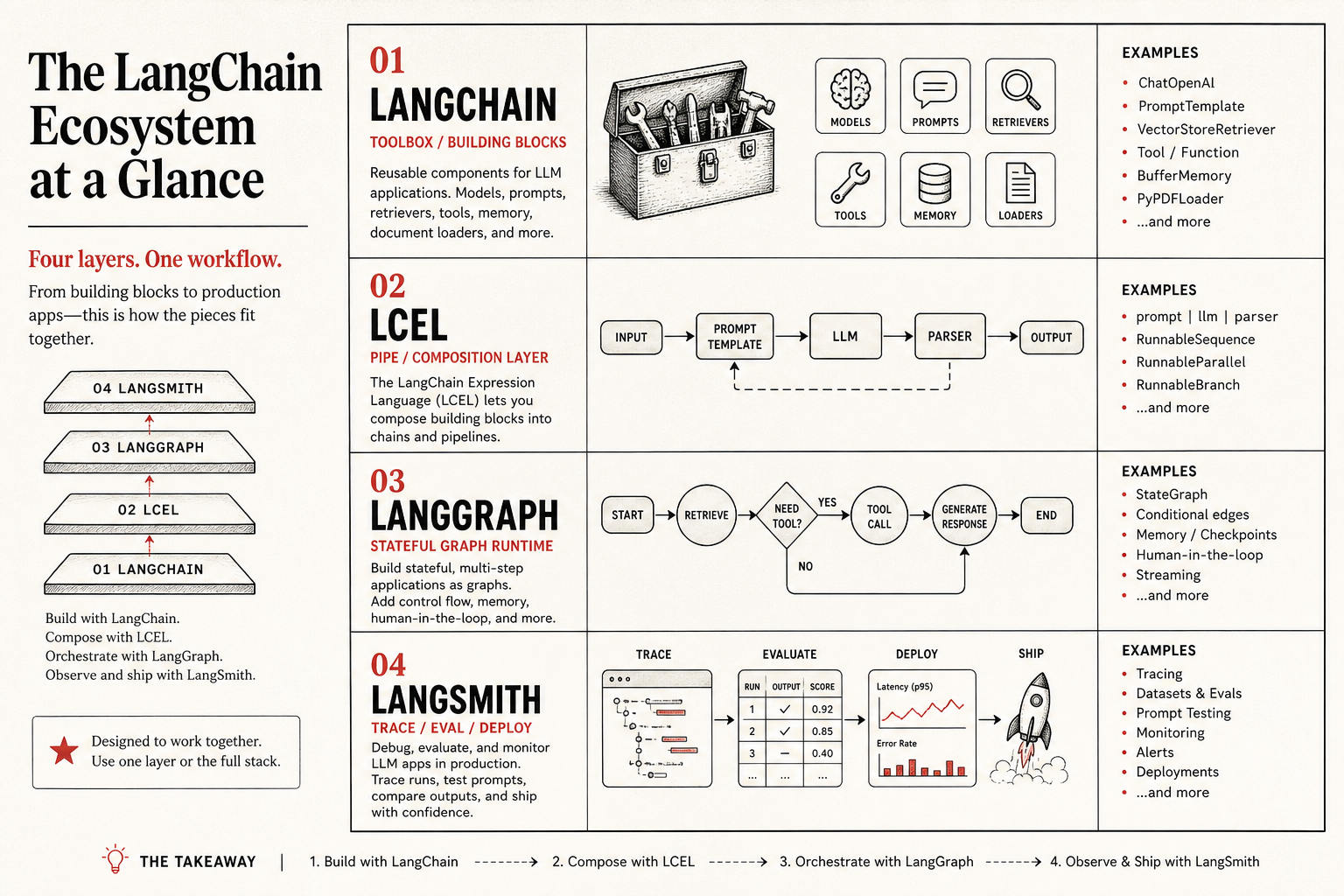
I will keep this beginner-friendly without dumbing it down. Claim, then evidence, then a link you can check. Omniscient Media frames the modern suite cleanly: LangChain the framework, LangGraph the graph runtime, LangSmith the observability and eval platform. That is the "agent engineering platform" story in three layers. I add LCEL as the fourth name because it is the glue syntax most tutorials skip past, and skipping it is how people end up thinking "LangChain" means one Python import.
Figure 1 · the stack
Four layers, one brand, different contracts
Layer 1LangChain is the toolbox, not the whole house
LangChain, in the narrow sense, is a library of composable building blocks: model wrappers, prompt templates, document loaders, retrievers, output parsers, memory helpers. Use it for linear pipelines, the kind where step A feeds step B and you are not yet asking the system to branch, loop, or pause for a human. TechJack Solutions puts the adoption numbers in context: the project launched in October 2022, founded by Harrison Chase, and by 2026 the core package sees 52M+ weekly downloads. That scale is real, and it is also why the brand name became a shorthand for everything the company ships, which is the confusion we are untangling.
Layer 2
LCEL is how you wire the toolbox together
LCEL (LangChain Expression Language) is the declarative pipe syntax: you chain Runnables with |, and every chain exposes invoke(), stream(), and batch() with consistent async semantics. Think of it as the wiring layer, not a separate product you "choose" instead of LangChain. Royfactory's v1 practical guide is the clearest post-reorg walkthrough I send people: LCEL is how LangChain-native code composes before you graduate into graph state.
# LCEL: a linear chain (conceptual)
chain = prompt | model | output_parser
chain.invoke({"topic": "agent memory"})
chain.stream({"topic": "agent memory"})  # same interface, streaming
Layer 3LangGraph is the runtime for stateful agents
When your workflow needs cycles, conditional branching, persistent state, or human-in-the-loop interrupts, you are in LangGraph territory. LangGraph models orchestration as a directed graph: nodes are steps, edges are transitions, and state is a typed object that survives across steps. Checkpointers (Postgres is the common choice) let you resume after a crash or rewind for debugging. The official persistence docs are the authoritative starting point.
By March 2026, LangGraph reached v1.1 with type-safe streaming and invoke APIs, per the practitioner's map writeup on Level Up Coding. I treat that as a maturity signal, not a reason to reach for graphs on day one. TechJack states the rule I repeat in every office hours: use LangChain for linear pipelines, LangGraph for stateful agents. Simple, and easy to ignore until your "linear" chain quietly grows a loop.
Figure 2 · which layer?
A decision tree for the naming confusion
Where each layer maps onto a full agent architecture, the six-component breakdown is worth a look alongside this map. LangChain covers model + retrieval primitives, LangGraph owns orchestration, LangSmith spans observability and eval. Naming clarity makes that mapping possible.
Layer 4
LangSmith is the lifecycle layer, and it is framework-agnostic
LangSmith is the commercial observability and eval platform: trace store, dataset store, experiment runner, and monitoring dashboard rolled together. Critically, Omniscient Media notes it was designed from day one to be framework-agnostic. Teams not on LangChain or LangGraph can still trace, evaluate, and compare runs. Since 2025 it also absorbed deployment concerns (LangGraph Platform capabilities), so the "observe only" box in older diagrams is incomplete.
The loop that actually pays off, trace to dataset to experiment to online eval, is the subject of the LangSmith in practice walkthrough. I will not repeat that playbook here. The ecosystem point is simpler: LangSmith is not "the logging tab inside LangChain." It is the place production failures become tomorrow's golden traces.
"LangSmith was deliberately designed from day one to be framework-agnostic: teams not using LangChain or LangGraph can still use it." (Omniscient Media)
What changed in v1 (and why older tutorials lie)
The October 2025 v1.0.0 release reorganized the surface area: higher-level agent abstractions converged on LangGraph, and legacy APIs moved to langchain-classic. Royfactory documents the migration paths better than the release notes alone. If your mental model predates v1, you may be importing patterns that still work but no longer represent where the company is investing.
I will name the honest counterpoints because fair-partisan is the job. The ecosystem sprawl (LangServe, LangFlow, Deep Agents, Fleet, and more) is itself overwhelming compared to a single-framework shop. LangSmith is closed-source, which matters for data residency. Migration friction from pre-v1 codebases is real. None of that invalidates the layering model; it explains why newcomers feel lost.
Figure 3 · the progression
Prototype → graph → observe throughout
Figure 4 · anchor numbers
Scale and the v1 inflection
Once you know the layers, framework choice gets easier
This map is intentionally pre-comparison. Once you know which layer you are shopping for, the LangGraph vs CrewAI enterprise comparison is the next read if your question is orchestration framework selection. LangGraph is one runtime choice; CrewAI bets on role abstraction instead of explicit graphs. Different argument, same prerequisite: know what job you are hiring the tool to do.
Four names, four jobs. Stop conflating them, and the rest of the ecosystem stops feeling like a maze.
That is the whole point. Learn the toolbox, learn the pipe syntax, learn when graphs earn their complexity, and wire observability before you need it. The brand is big on purpose. Your architecture does not have to be.
Comments (4)
Join the discussion
Sign in to comment, bookmark threads, and continue lessons across sessions.