I read Microsoft Build the way I read any enterprise keynote: ignore the demo reel, follow the identity arrows. Copilot is a distribution channel, not an architecture. That sentence is the whole conference for anyone who has to sign off on audit logs, not just wire up a LangGraph node. Build 2026 did ship real agent infrastructure, hosted runtimes, an optimizer loop, framework-agnostic hosting. But the enterprise story is who gets to call which tool, under whose tenant, with what policy attached, and whether you can find every agent your company already has.
I followed Build from Seattle on the livestream and the Foundry blog posts that landed the same afternoon, so treat this as an architect's triage, not a partner win. The pattern that mattered to me was not "Microsoft has agents now." It was that Microsoft drew a full stack from GitHub harness to employee inbox, then hung governance on every hop in between.
Build 2026 · Day 1 keynote
Three layers, one platform story
The cleanest map in the coverage is the three-layer frame from the Foundry agent service post: Build (the harness), Deploy (hosted agents in Foundry), Operate (tracing, evaluation, Agent Optimizer). A fourth beat, reach, shows up in the "what's new" post as publishing into Teams and M365 Copilot with identity, permissions, and policy flowing through automatically, GA planned June 2026.
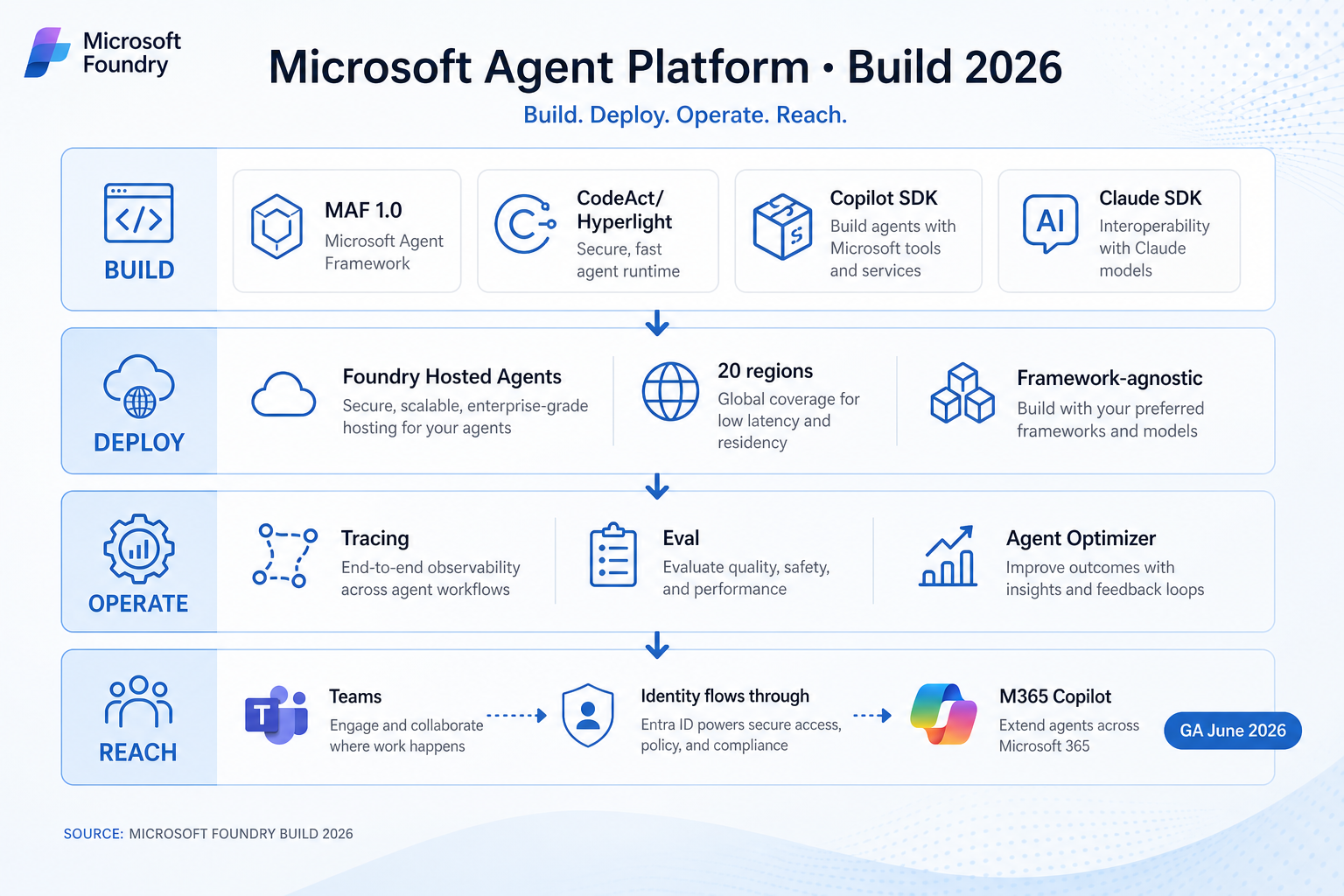
That stack is coherent. It is also a commitment device. Once your harness, runtime, observability, and employee-facing surface all share one control plane, "framework-agnostic hosting" stops being a kindness and starts being a funnel. You can bring LangGraph or the Claude Agent SDK, but the registry, policy, and audit trail live in Foundry either way.
Who owns the registry?
The line that stuck with me from the Foundry coverage is almost boring on purpose: "Production agents shouldn't force a framework choice up front. Microsoft Foundry treats the agent harness as a flex point, not a lock-in." Fair. But flex at the harness layer only helps if someone upstream owns the inventory of what is running, who published it, and which tools each agent may call. That inventory is the registry problem, and Build answered it by making Foundry the default place agents land before they reach Copilot.
Figure 1 · Identity flow-through
Publish path: harness → Foundry → employee surface
If you are comparing harnesses, the MAF and AutoGen migration story is worth a look for where Microsoft wants greenfield builds to land. My read is narrower: treat Copilot as the inbox, Foundry as the control plane, and every agent as a governed service before it is a demo.
Operate layer
Optimizer loops are governance, not a feature slide
The Agent Optimizer announcement is easy to dismiss as another "AI fixes AI" slide. In an enterprise context it is closer to a change-management workflow: production failures become ranked, reviewable proposals instead of silent prompt tweaks in someone's private fork. That is the same instinct as a proper eval gate, just sold as a managed loop.
CodeAct and Hyperlight sandboxing (preview) push in the same direction from the execution side: fewer model turns, approvals at execute_code granularity. For teams already nervous about agents running tools, that granularity is the part to watch, not the benchmark chart.
Figure 2 · Registry ownership
Without a registry, "framework-agnostic" just means invisible sprawl
On the tool boundary specifically, the production patterns in the MCP production server guide are an interesting read for how authz and audit should look once agents leave the demo laptop. Build is selling the Azure-shaped version of the same problem.
MondayWhat I would do with this announcement
Pilot checklist
Separate the June 2026 GA dates from today's preview status before anyone puts "Copilot agent" on a roadmap slide. Run one harness (MAF or your existing LangGraph service) through Foundry hosted agents in a single region, with Entra groups mapped explicitly, and require a registry entry before any Teams publish. Treat Agent Optimizer output as a human-reviewed change queue, not auto-deploy. Write down who owns the registry on your side, because Microsoft's default answer is Foundry.
Build 2026 did not solve enterprise agents. It did name the right control points: identity flow-through, hosted runtime, optimizer loop, inbox distribution. For a season-level read across I/O, Cloud Next, and Interrupt, the 2026 conference roundup is worth a look once those pieces are live.
Copilot is where employees meet the agent. Foundry is where you prove you knew what it would do before it got there. Build spent its agent keynotes connecting those two sentences.
Comments (3)
Join the discussion
Sign in to comment, bookmark threads, and continue lessons across sessions.