I take keynote notes the way I read a release: claim, then evidence, then a source you can open. So let me put the thesis up front before the demo reel fades from memory: separate what shipped from what got a stage. Google I/O 2026 spent most of its agent runtime on things you cannot deploy on Monday, and the few things you can are the ones worth reorganizing your backlog around.
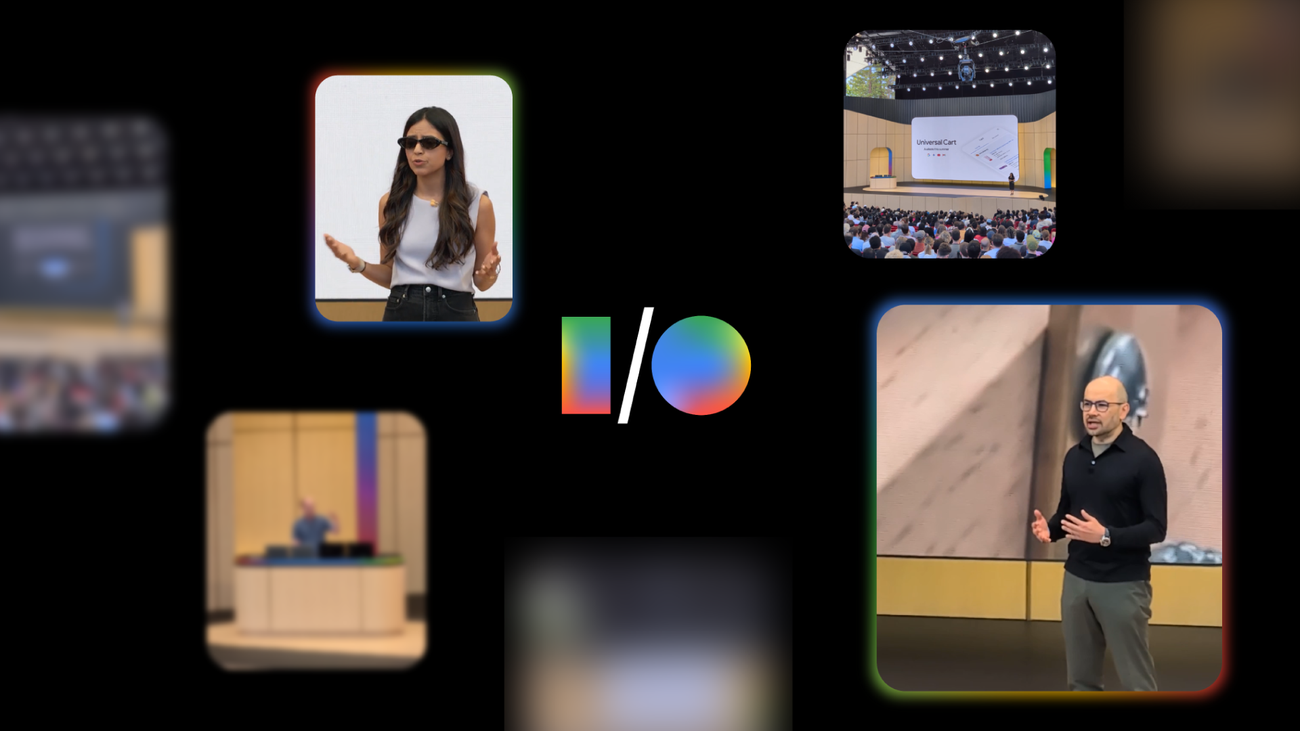
I watched the developer keynote in May 2026 on the livestream out of Shoreline, not from a press seat, so treat this as a researcher's triage rather than a victory lap. The pattern was familiar to anyone who has covered a few of these: the headline reasoning demos are aspirational, and the infrastructure that builders actually wire into is mostly in preview. The trick is not to be cynical about that, it is to read the tier label on every box before you plan against it.
Where you were
What shipped, and what merely got a slide
The cleanest way to make sense of two hours of agent talk is to drop each announcement into an availability bucket. One product was genuinely GA. One desktop harness shipped alongside it. The reasoning layer most people will quote from the keynote is a developer preview, and the browser-side standard everyone got excited about is a proposal with an origin trial attached. Same keynote, four very different commitments.
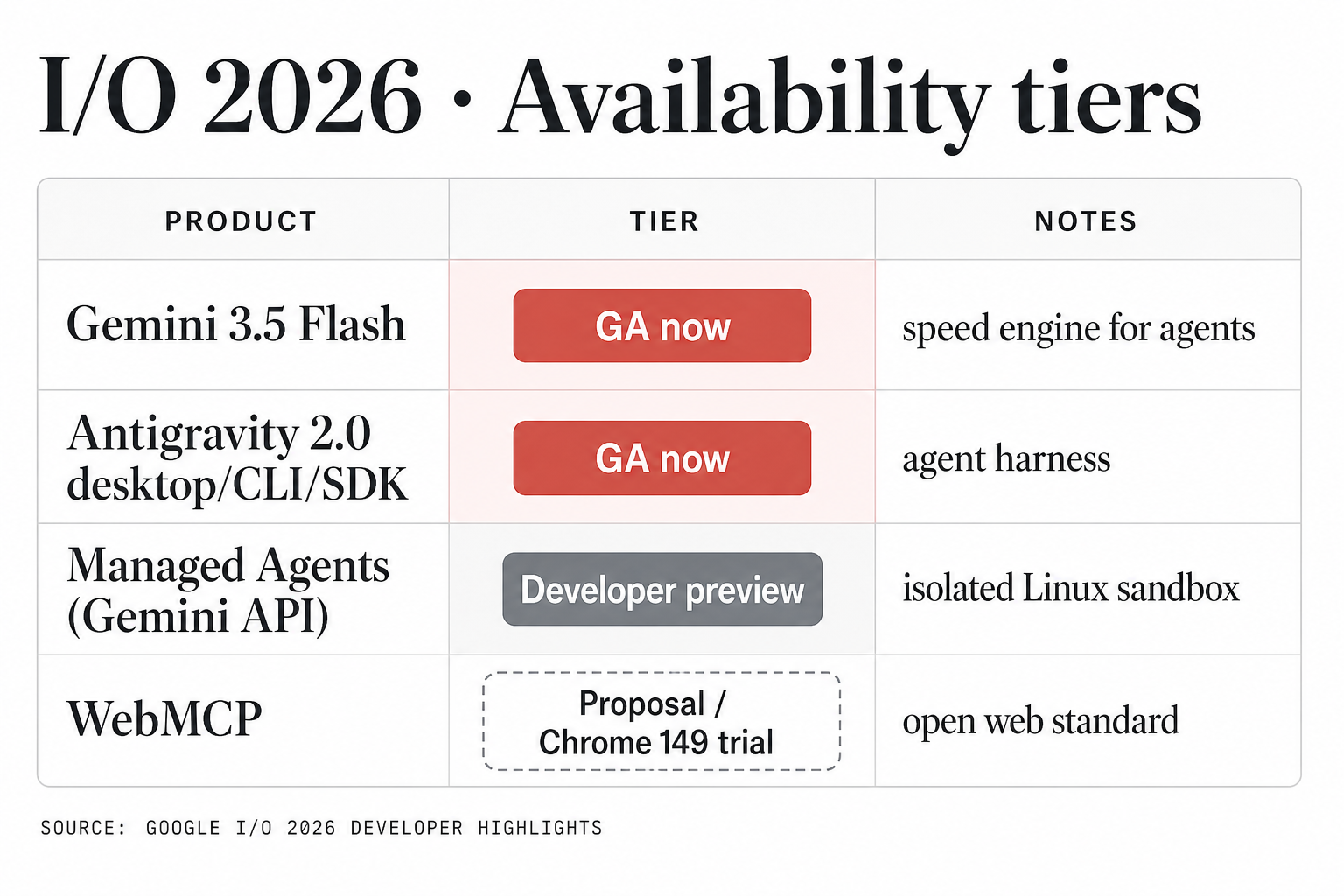
That same triage is easier to read as a stack than a table, so here it is in the kit's idiom, one row per tier.
Figure 1 · the I/O 2026 agent stack, by tier
One keynote, three very different commitments
The shipping engineGemini 3.5 Flash is the real launch
If you strip the keynote down to one durable claim, it is the speed play. Google framed it directly: "We're accelerating the shift from prompts to action with the launch of Gemini 3.5 Flash." The substance behind the line is what matters to builders: Gemini 3.5 Flash launched generally available, the highlights post says it outperforms Gemini 3.1 Pro on most benchmarks, and it runs roughly four times faster than other frontier models. That combination, near-Pro quality at Flash latency and price, is exactly the profile an agent loop wants when it is making dozens of tool calls per task.
This is the announcement I would actually re-architect around, and it is also the one that quietly raises the stakes. A model that is four times faster does not just save wall-clock time, it lets an agent take four times as many unverified actions in the same window. Speed is a force multiplier for both correct and incorrect plans, which is a theme worth carrying out of the keynote and into your evaluation harness.
The keynote's most ambitious agent story was not the model, it was the harness wrapped around it.
Managed Agents and the Antigravity harness
Here is the headline that got the loudest reaction and the asterisk it deserves. Google described Managed Agents like this: "With a single API call, you can now spin up an agent that reasons, uses tools and executes code in an isolated Linux environment." That is a genuinely useful primitive. Managed Agents reuse an env_id across calls, so the sandbox keeps its state, files, and installed packages between requests instead of starting cold every time. For multi-step work, persistent state is the difference between an agent and a stateless function call.
The asterisk: it is a public preview, not GA. The harness underneath it, Antigravity 2.0, did ship as a desktop app plus an agy CLI, an SDK, and the Managed Agents service, with sandboxing, credential masking, and a hardened Git surface. So the local tooling is real and usable today. The hosted, single-API-call agent service that drew the applause is the part you should prototype against and explicitly not promise to a customer until it carries a GA label.
Triage note
Antigravity 2.0 (desktop, agy CLI, SDK) is GA and yours to use now. Managed Agents, the hosted "one API call spins up an agent" service, is a preview. Same product family, two different commitment levels. Read the label, not the demo.
Is WebMCP a standard or a slide?
The announcement that lit up my corner of the timeline was WebMCP, browser-side tool exposure so a page can offer its own capabilities to an agent. Google was careful with the wording, and so should we be: "WebMCP is a proposed open web standard... The experimental WebMCP origin trial starts in Chrome 149." Proposed. Experimental. Origin trial. Three hedges in two sentences, all of them load-bearing.
I am bullish on the idea and bearish on betting infrastructure on it this quarter. WebMCP overlaps conceptually with the Model Context Protocol that tool authors already target, which means standard proliferation is a live risk: maintainers could end up supporting two tool-exposure surfaces that do similar jobs. If you are weighing where the registry and control-plane questions land between these standards, my colleague's read on the MCP ecosystem and who controls the registry is worth a look before you commit to either side. For now, WebMCP belongs in the watch column: track the Chrome 149 trial, file feedback, do not rebuild your tool layer around a proposal.
The enterprise read
Persistent agents move cost and governance, not just convenience
The consumer framing made the persistent-agent bet explicit: Gemini Spark as a 24/7 consumer agent and Search information agents mirror the same always-on posture the developer tools are heading toward. That is the direction. The keynote was quieter about the bill that comes with it. An agent that runs continuously and acts four times faster is an agent that consumes tokens, holds sandbox state, and touches systems around the clock, and the cost and governance of that were glossed in favor of the demo.
Figure 2 · the only sorting that matters
What got a stage vs what got a ship date
Faster, cheaper frontier inference also widens a gap that does not show up in a demo: the distance between how fast an agent can act and how fast you can verify what it did. For why a quicker Flash makes verification, not capability, the binding constraint at enterprise scale, the analysis of frontier models and enterprise impact is an interesting read alongside this.
What to do MondayRe-sort the backlog by availability tier
The practical move is boring and that is the point. Take whatever you scribbled during the keynote and re-sort it by the tiers in Figure 1, not by how impressive the demo felt. Move Gemini 3.5 Flash and Antigravity 2.0 into "evaluate this sprint," because they are GA and the speed profile is worth a real benchmark on your own agent loop. Put Managed Agents and Chrome DevTools for agents into "prototype, no customer promises," because previews change. Park WebMCP and Gemini Spark in "watch," with a calendar reminder on the Chrome 149 origin trial. If a stakeholder asks why a keynote headline is not on the roadmap, the answer is the tier label, and that is a defensible answer.
I/O is one stop in a crowded season, and reading any single keynote in isolation tends to overweight it. For the wider context of how this slots against the year's other agent events, the 2026 agent conferences roundup is worth taking a look at.
The useful question after I/O 2026 is not "is Google serious about agents." It obviously is. The question is "which of these can I deploy this quarter," and the honest answer is one model, one harness, and a list of things to watch.
Adopt what shipped, prototype what previewed, track what was proposed. The keynote did its job by showing the direction. Your job is to refuse to confuse a direction with a dependency.
Comments (4)
Join the discussion
Sign in to comment, bookmark threads, and continue lessons across sessions.